Why 40GBASE-LR4 Still Matters in Today’s Infrastructure
It’s fashionable to say that 40G is already outdated, especially in conversations dominated by 100G, 400G, and even higher speeds. But real networks do not evolve at the pace of marketing slides. Many production environments still depend on 40G links, and not because they are behind, but because their traffic profiles, budgets, and risk tolerance do not justify constant upgrades.
This is where 40GBASE-LR4 optical modules continue to earn their place. They offer a stable and proven way to deliver long-distance 40G connectivity without forcing a network to jump prematurely into higher-speed architectures. In many cases, LR4 is not a temporary workaround but a deliberate, long-term design choice.
Understanding 40GBASE-LR4 Without the Textbook Language
From a technical standpoint, 40GBASE-LR4 transmits four parallel 10 Gbps channels over four different wavelengths, multiplexed onto a single pair of single-mode fibers. The typical reach is up to 10 kilometers. That description is accurate, but it doesn’t explain why engineers still choose it.
What really matters is that LR4 behaves predictably. It uses standard duplex single-mode fiber, fits into QSFP+ ports, and does not require special cabling or advanced configuration. You plug it in, validate the link budget, and move on. In operational networks, that simplicity is often more valuable than raw performance gains.
Where 40GBASE-LR4 Is Commonly Deployed
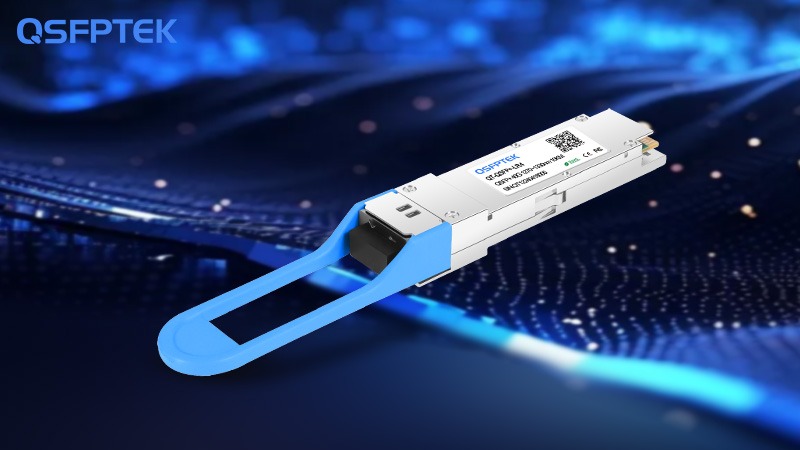
You will still find 40GBASE-LR4 modules modules in campus backbones, industrial networks, metro aggregation layers, and inter-building links. These environments often sit in the “middle distance” range — too far for SR4, but not demanding enough to justify 100G or coherent optics.
Many enterprises upgraded from 10G to 40G years ago, and those platforms remain perfectly serviceable. LR4 allows them to extend or reorganize their networks without tearing out existing infrastructure. In practice, that often means fewer disruptions and much lower upgrade risk.
40GBASE-LR4 vs SR4: Why Reach Changes Everything
SR4 is efficient and inexpensive for short distances, but it relies on parallel fiber and quickly becomes impractical beyond a few hundred meters. LR4 removes that limitation entirely by using single-mode fiber and wavelength multiplexing.
This difference has real operational consequences. Single-mode fiber is easier to manage over long distances, easier to document, and often already deployed between buildings or sites. Choosing LR4 avoids the need to introduce parallel fiber trunks just to support a single link.
Operational Behavior Over the Long Term
One of the strongest arguments for LR4 is its long-term stability. Once installed, these modules tend to operate quietly for years. Power consumption is higher than short-reach optics, but still well within QSFP+ specifications. Thermal behavior is predictable, and most modern switches are designed to handle it without special cooling.
When problems occur, they are usually external to the module itself. Dirty connectors, fiber degradation, or physical damage account for most issues. The optics rarely fail without warning, and monitoring data is usually clear enough to identify problems quickly.
Interoperability and Multi-Vendor Environments
In mixed-vendor networks, LR4 modules are generally well-behaved. As long as they comply with industry standards, interoperability issues are uncommon. This makes LR4 particularly attractive in environments where switches and optics are sourced from different vendors.
For operators who value flexibility and want to avoid vendor lock-in, this is an important consideration. A technology that only works reliably within a single ecosystem becomes a liability over time.
Cost Considerations Beyond the Module Price
It is true that LR4 modules cost more than SR4. However, focusing only on module pricing ignores the broader picture. Parallel fiber installation, additional patch panels, and long-term maintenance costs often outweigh the price difference between optics.
By using existing single-mode fiber, LR4 reduces deployment complexity and avoids hidden costs that surface years later. Over the life of the network, that often translates into a lower total cost of ownership.
Why Not Jump Straight to 100G?
In theory, moving directly to 100G sounds efficient. In practice, it often triggers a chain of upgrades: new switches, higher power budgets, different optics, and sometimes even changes to the fiber plant. For networks that do not yet need 100G bandwidth, this can introduce unnecessary risk and expense.
LR4 offers a middle path. It provides enough capacity for many use cases while keeping the existing architecture intact. That measured approach aligns better with how most real networks are planned and funded.
Conclusion
40GBASE-LR4 is not a legacy technology hanging on by inertia. It remains relevant because it solves a specific problem very well: delivering reliable, long-distance 40G connectivity in networks that prioritize stability and controlled evolution. For organizations that value predictability over headline speeds, LR4 continues to be a sensible and defensible choice.