What Is a 100GBASE-ZR4 Optical Module?
The 100GBASE-ZR4 optical transceiver pushes Ethernet well beyond typical data center distances. While LR4 modules usually top out around 10 km, a 100GBASE-ZR4 transceiver is designed for much longer reaches — often up to around 80 km on single-mode fiber, depending on link budget and fiber quality. That’s a huge step up and moves 100G Ethernet into the territory that used to belong mostly to carrier and transport gear.
Like other 100GBASE-xxx modules, the ZR4 typically comes in QSFP28 form factor. It carries four optical lanes, each at 25G, over different CWDM wavelengths. Those four lanes are multiplexed into one optical signal and transmitted over a duplex LC connection. At the far end, the reverse process recovers the four separate 25G lanes.
Key Features of 100GBASE-ZR4 Long-Distance Transceivers
The main feature of a 100GBASE-ZR4 transceiver is its extended reach. It uses higher launch power and more sensitive receivers — often with APD (avalanche photodiode) technology — to maintain signal integrity over very long fiber paths. This allows it to span distances that easily cover metro rings, inter-city connections, and long campus or regional links.
Another important aspect is that it still speaks “plain” 100G Ethernet. You’re not dealing with exotic proprietary optical transport protocols. From a switch or router point of view, it’s just a normal 100G port. That can dramatically simplify network design, since you can use standard routing or switching features over what is essentially a long-haul link.
Where 100GBASE-ZR4 Is Used
100GBASE-ZR4 is often used for data center interconnect (DCI) between geographically separated facilities. For example, if you have two data centers in the same city or within a neighboring city, a ZR4 link can connect them directly over existing dark fiber. You get native 100G Ethernet from site to site without needing transponders or extra optical shelves.
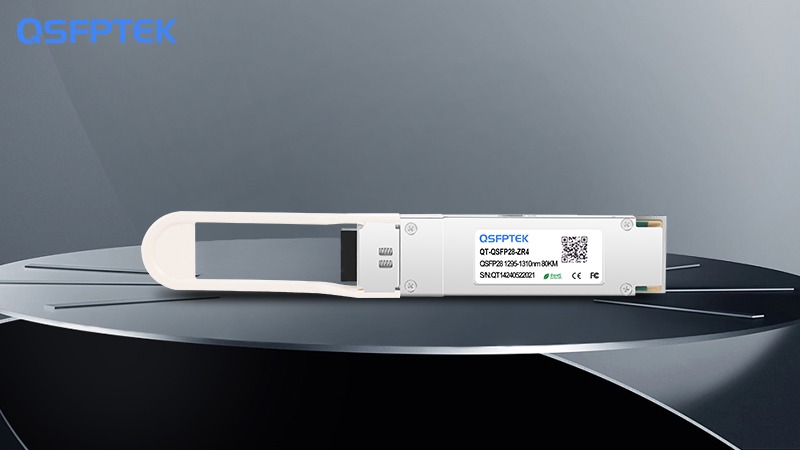
Telecom operators and ISPs also use ZR4 optics to connect core nodes or aggregation points where 100G capacity is needed but full DWDM systems might be overkill. It’s a middle-ground option that simplifies some deployments while still providing serious reach.
100GBASE-ZR4 vs 100GBASE-LR4 and ER4
Compared with 100GBASE-LR4, which usually supports up to 10 km, and 100GBASE-ER4 (around 40 km), the ZR4 extends that distance further, roughly doubling the ER4 range in many designs. Of course, that extra reach comes with trade-offs: ZR4 modules typically cost more, consume more power, and may require more careful planning of optical budgets and fiber quality.
However, when you genuinely need that long reach, there aren’t many plug-and-play options that are simpler than ZR4. You stay inside the Ethernet world, without converting to SONET/SDH or other transport layers.
Practical Considerations for Deploying 100GBASE-ZR4
Long-distance 100G links aren’t just about plugging in a module and hoping for the best. Fiber condition, splices, connectors, and patch panels all affect performance. With 100GBASE-ZR4, you usually have to pay more attention to optical budget calculations, attenuation, and dispersion. Even so, the overall design is often simpler than building a full DWDM system for a single 100G service.
In some networks, operators will start with 100GBASE-ER4 for intermediate distances and step up to ZR4 only when the fiber span and loss profile demand it. This lets them balance cost and capability more precisely.
Conclusion
The 100GBASE-ZR4 optical transceiver extends 100G Ethernet into true long-haul territory. It allows switches and routers to talk directly over tens of kilometers of single-mode fiber, making it a powerful option for data center interconnects, metro backbones, and regional links. It’s not the cheapest or simplest optic in the catalog, but when you need native 100G over serious distance, ZR4 is one of the cleanest ways to get there.